

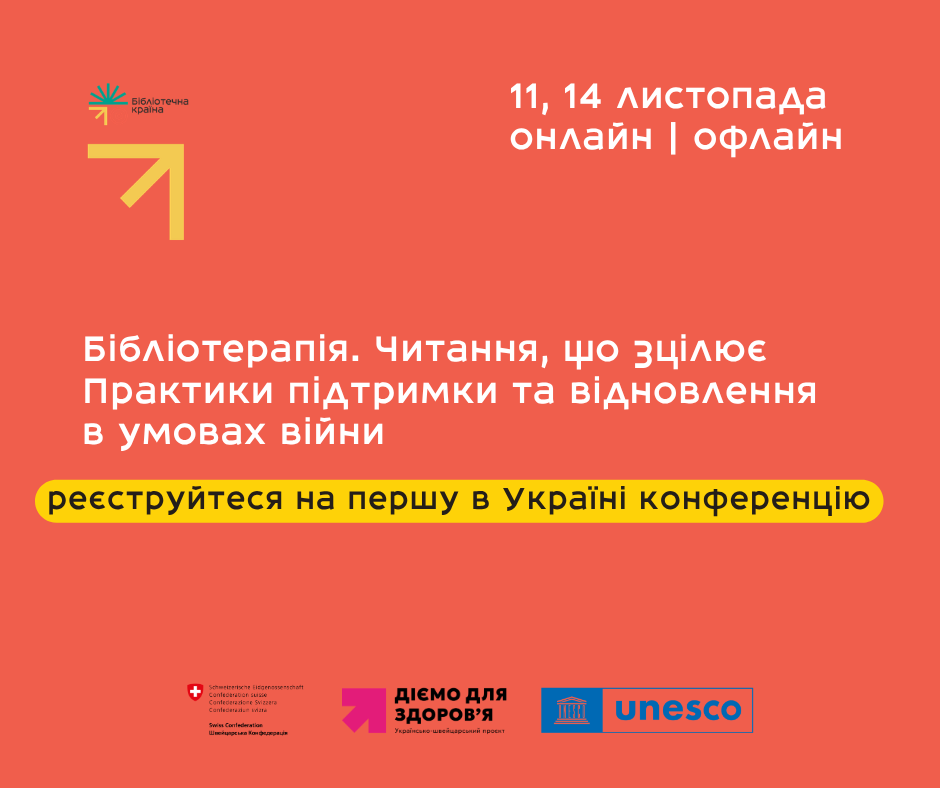
Ukraine's First Conference on Bibliotherapy: Registration Is Now Open
Ukraine's First Conference on Bibliotherapy: Registration Is Now Open
We invite you to the first academic and practice-oriented conference on bibliotherapy in Ukraine, “Bibliotherapy: Reading That Heals. Practices of Support and Recovery in Times of War,” organized by the Charitable Foundation “Library Country”.
What happens to the way we read during wartime — and why do certain books become a source of support in the most difficult moments? What experience can we learn from the United Kingdom, France, and Hungary? Can artificial intelligence help with selecting and evaluating books for bibliotherapy? These are just some of the questions we will explore at Ukraine’s first international academic and practice-oriented conference on bibliotherapy.
11 November — Pre-conference, online
We will discuss the role of books and culture during wartime, the Ukrainian experience, and international models of bibliotherapy. The conversation will bring together international experts and representatives of professional communities.
14 November — Conference, in person in Kyiv
This day will be more practice-oriented: Ukrainian case studies, an exchange of tools and approaches, and three parallel workshops. At the end of the day, an open space will give us an opportunity to discuss where bibliotherapy in Ukraine can go next.
Libraries are already using reading as a tool for support: creating thematic book selections, hosting reading groups, organizing group-based practices, and working with different audiences. At the same time, the war is creating new needs and increasing the demand for accessible psychosocial support practices. This makes it important to understand how to build on existing experience and which approaches and tools can be applied in different situations.
What will you take away from the conference?
A professional understanding of bibliotherapy.
You will explore how the field has developed, how approaches to using reading with different audiences have changed, and what role bibliotherapy can play in a modern library — from supporting psychosocial well-being and helping people make sense of difficult experiences to developing reading communities and promoting reading.
Practical tools for your work.
You will discover methods, formats, and case studies from Ukrainian libraries and professionals from related fields. You will see how bibliotherapeutic practices work in specific situations and which elements of this experience can be adapted to your own library.
An international professional context.
You will learn how bibliotherapy is developing in other countries: which approaches are used, how professionals are trained, and what models of cooperation between libraries, psychologists, educators, cultural organizations, and social institutions are already working. We will also discuss which of these solutions may be relevant for Ukrainian libraries.
A professional community.
The conference will bring together librarians who are already using reading-based support practices or would like to develop this area in their libraries. It is an opportunity to meet colleagues, exchange experience, learn about practices from other libraries, and build professional connections for future cooperation. Psychologists, educators, cultural professionals, and representatives of civil society will also join the conversation, bringing knowledge and experience from related fields into library practice.
And perhaps most importantly — a shared understanding of the role a library can play in supporting people and strengthening communities: which professional functions it can develop, what forms of interaction with readers it can build, and what role reading can play as a tool for support, making sense of experience, developing reading communities, and strengthening connections between people.
Register and join the professional conversation.
Registration form.
The conference is supported by the Swiss-Ukrainian project “Acting for Health,” implemented by the Government of Switzerland, and by UNESCO.